Concrete Block Walls Explained: Sizes, Strengths and Uses
What a block actually is
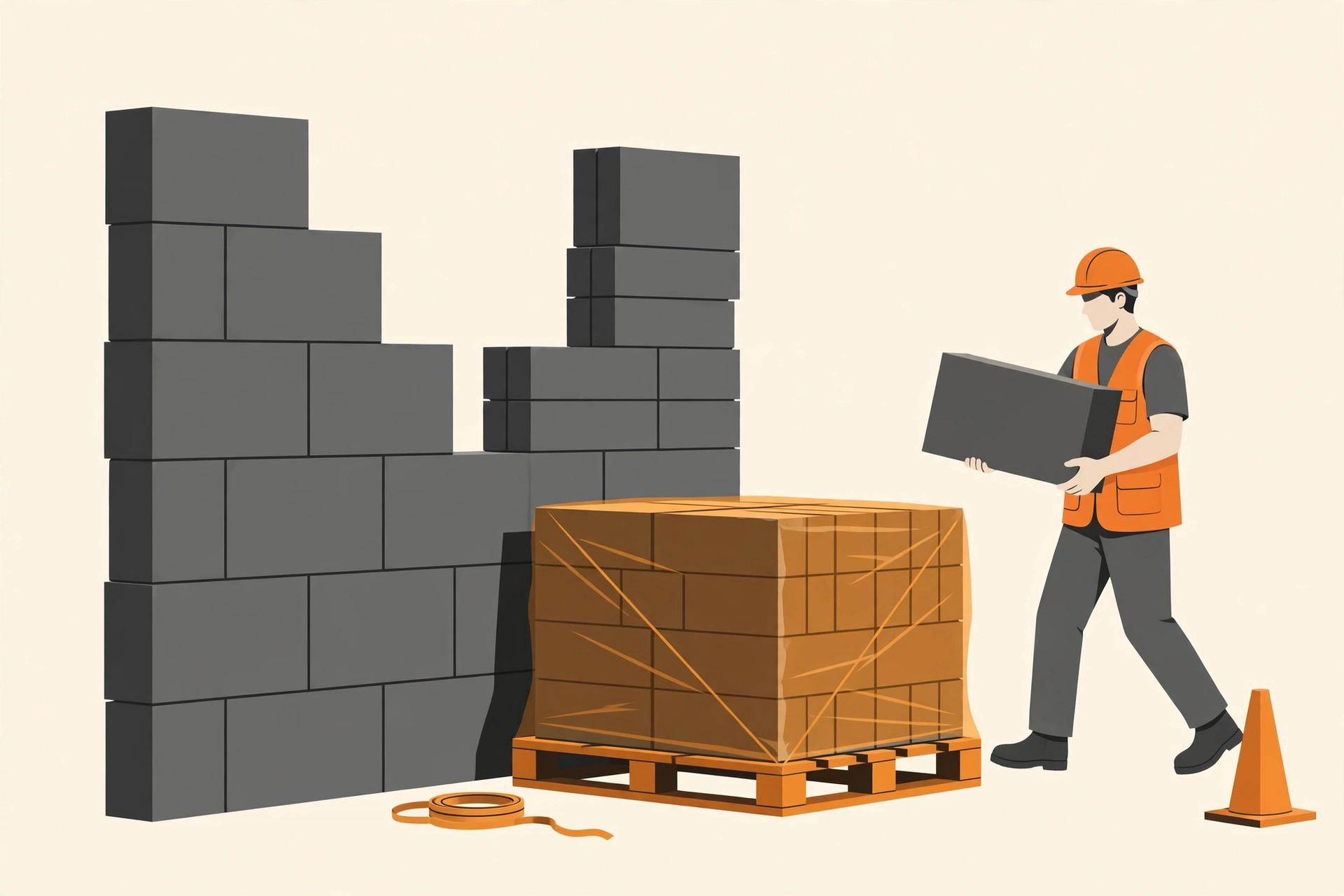
A concrete block is a brick scaled up: one UK block of 440 by 215 millimetres lays the face of about six bricks, which is why block walls rise so quickly. Blocks come in densities from lightweight aerated to dense aggregate, and in strengths matched to their duty, from light internal partitions to loadbearing external leaves. Thickness is the working dimension: 100 millimetres for standard internal and single skin work, wider for external, acoustic and retaining duties. About ten blocks cover a square metre with standard joints, the counting figure the whole trade carries in its head, and packs arrive wrapped in counts that suit that arithmetic.
Where blocks earn their keep
The cavity wall of a modern house is usually a block inner leaf carrying the floors and roof, tied to a brick or render outer leaf. Blocks also rule in internal partitions, garden walls, garages, extensions and foundation walls below ground where their size speeds the slow work. Aerated lightweight blocks cut easily, fix well and insulate; dense blocks carry load and block sound between dwellings. In hot climates the solid block wall, rendered both sides, is the standard house wall entire. Choosing the block is choosing the wall's character: strength, weight, insulation and sound all ride on that one decision, so read the specification rather than grabbing the cheapest pack on the yard.
Counting, handling and laying well
Count blocks by face area like bricks: wall area times ten per square metre for standard sizes, less a deduction for openings, plus five percent for cuts and damage. Blocks are heavy and thirstier than bricks; a 100 millimetre dense block is a two handed lift all day, so plan the stacking, the cutting station and the mortar supply before the gang starts. Lay to a line with full bed and cross joints, keep perpends staggered, and tool joints as you go on face work. Wet very dry blocks lightly in hot weather so they do not steal the mortar's water before it sets. Store packs flat, covered and off the mud, and a block wall will go up straighter than the sceptics expect. Cut blocks with a bolster or a saw at one set station, never snapped hopefully at the wall, and the face work stays clean while the offcuts pile up in one place, ready to be reused as halves, closures and piers instead of being swept into the skip.