Gravel and Aggregates: A Buyer's Guide
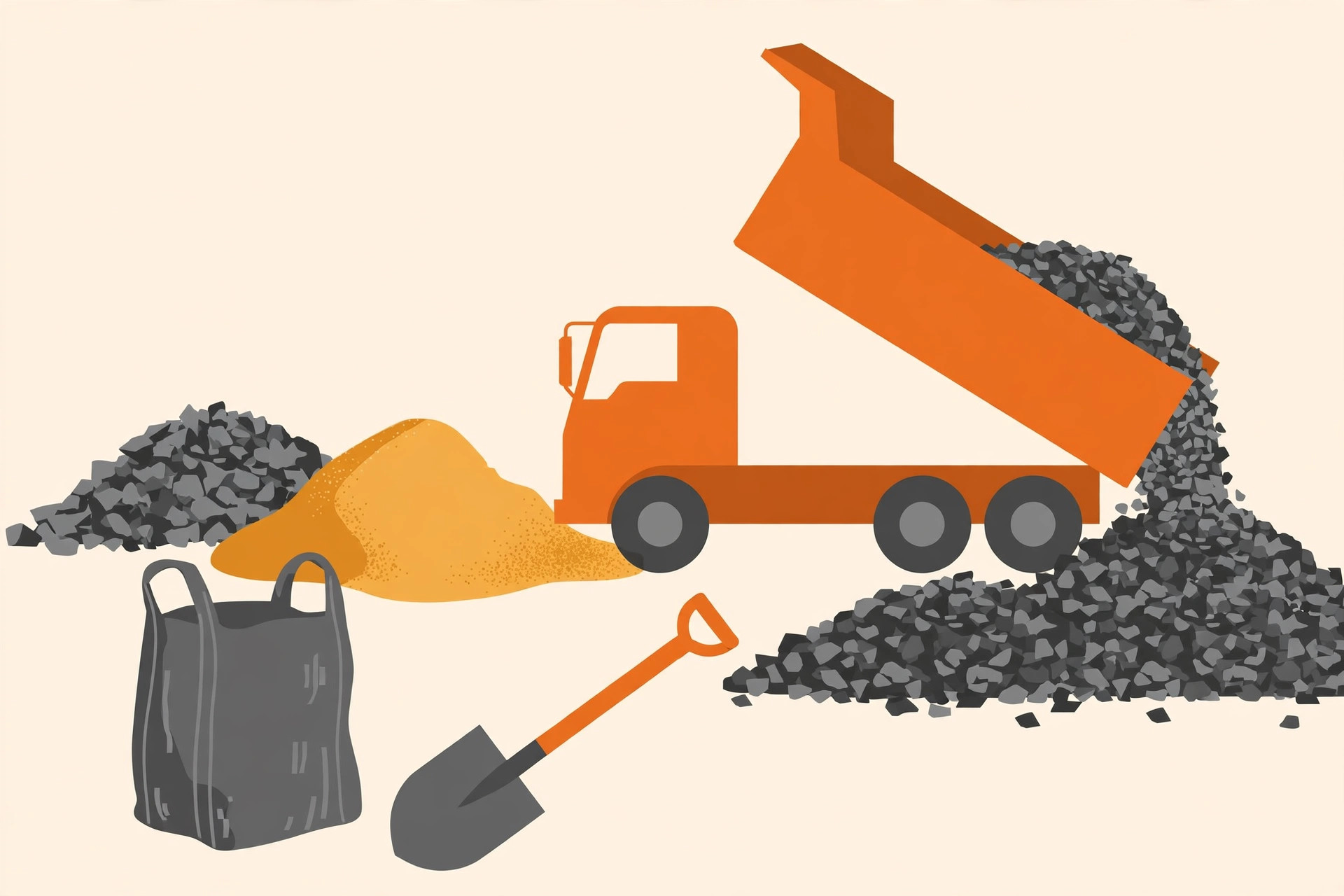
Four materials that get confused daily
Gravel is rounded or crushed stone in a stated size, 10 or 20 millimetre being the driveway and drainage standards. Crushed stone is angular, fresh from the crusher, and locks together under compaction, which makes it the base material gravel can never be. Sand divides into sharp sand for concrete and screeds, soft building sand for mortar, and coarse grit for bedding. Ballast is sand and stone already mixed in roughly the proportion concrete wants, sold for the mixer rather than the landscape. Ordering the wrong one is the classic beginner tax: rounded gravel in a base layer rolls like ball bearings, and soft sand in concrete steals its strength. Name the job when you order, and a good yard will steer the material to match.
Density turns area into tonnage
Aggregates are spread by volume and sold by weight, so density is the exchange rate. Loose gravel and crushed stone run about 1500 to 1600 kilograms per cubic metre, ballast nearer 1750, sands around 1600 to 1650 depending on moisture. A cubic metre is a tonne and a half or more, which is why the tonne price that looked cheap becomes serious across a driveway. The calculation is always area times depth for volume, then volume times density for weight. Fifty millimetres over a 20 square metre drive is one cubic metre, about 1.6 tonnes of gravel: small numbers that surprise people expecting a couple of bags to stretch. Bulk bags hold roughly 850 kilograms, a bit over half a cubic metre, which is the unit most domestic orders are really counted in.
Depths, layers and honest allowances
Depth is a structural choice wearing a cosmetic hat. A decorative gravel dressing works at 25 to 40 millimetres over a proper base; laid straight onto soil at that depth it migrates, muddies and vanishes within a year. Driveway construction is layers: excavate, compact the formation, lay a crushed stone sub base at 100 millimetres or more compacted in passes, then dress with gravel at 40 to 50. Each layer is its own calculation and its own delivery. Order each layer a little proud, because compaction eats volume and a sub base that finishes thin cannot be thickened by the dressing. Keep a record of what went where and how deep; the next project on the same ground will ask, and memory lies kindly.