How to Measure a Roof Without Climbing It
The projection method, step by step
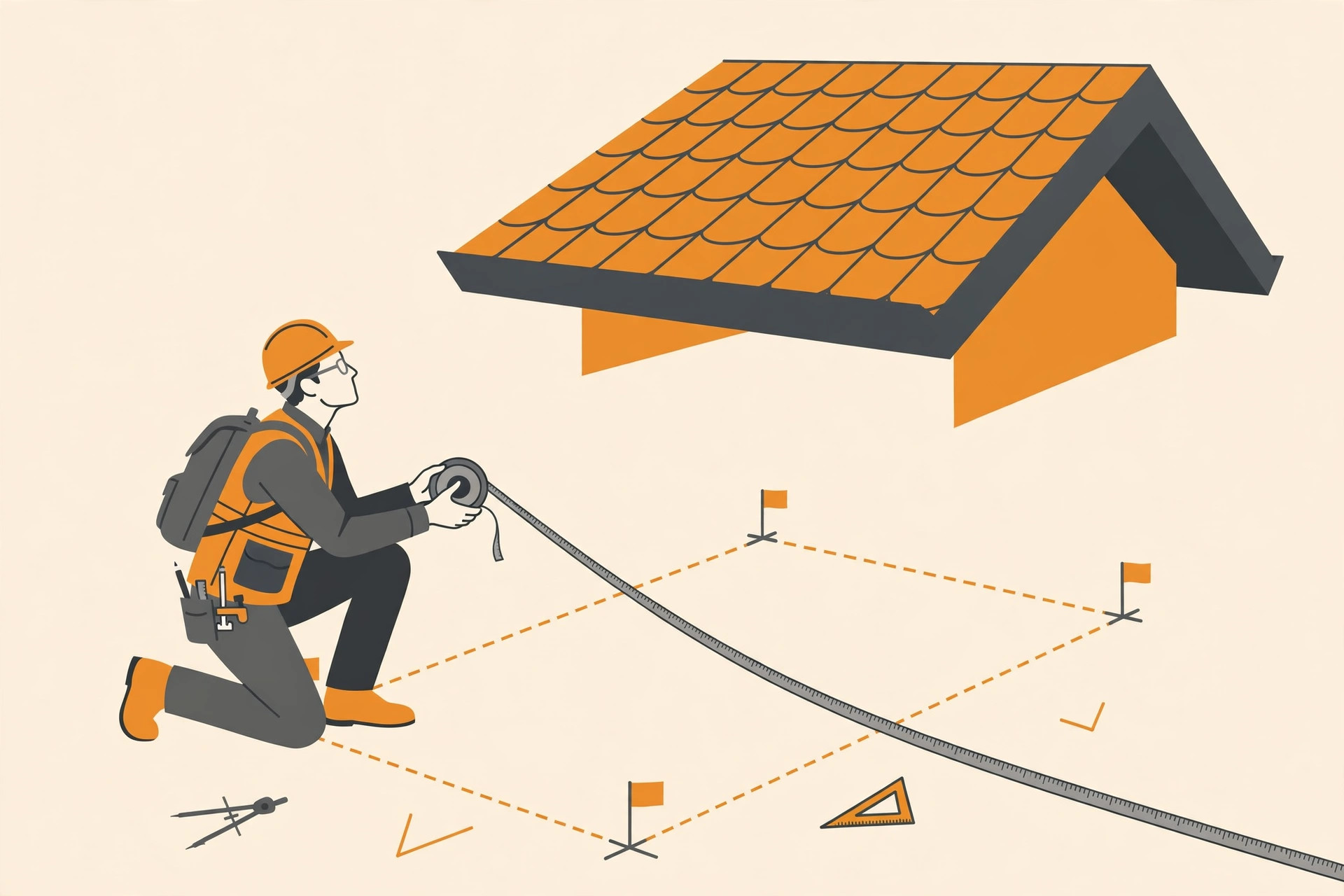
You rarely need to climb and tape a roof slope. Measure the building footprint at ground level, length and width, and add the eaves overhang on each side, because the roof covers the overhang too. That gives the plan area of the roof as seen from above. Then divide by the cosine of the pitch angle, or multiply by the rafter multiplier for your pitch, and the plan area becomes the true slope area. A 10 by 8 metre footprint with half metre overhangs is 99 square metres on plan; at a 30 degree pitch the multiplier is about 1.155, giving roughly 114 square metres of covering to buy. One measurement, one multiplication, and the merchant's number and yours finally agree.
Hips, valleys and honest adjustments
The projection method stays honest for gable roofs and is a good servant for simple hips, because a hip roof's slopes still project onto the same footprint. Valleys do not change the area much, but they change the cutting: allow extra for valley boards, the tiles lost in valley cuts, and the ridge pieces that hips consume in place of plain slope. Dormers, chimneys and roof windows subtract a little area and add a lot of flashing, so deduct only their honest footprint and never forget their lead and labour. Complex roofs, with intersecting wings at different pitches, defeat the single projection; split them into rectangles on paper, project each at its own pitch, and add the pieces.
Squares, bundles and the waste conversation
In American practice the roof is counted in squares of 100 square feet, and shingles come in bundles of three to the square. Metric merchants sell tiles by the thousand with a stated coverage per square metre at a stated gauge, and changing the gauge changes the count, so the batten gauge belongs on the order. Waste runs 5 percent on a plain gable, 10 on a hipped roof, and 15 where valleys and cuts multiply. Underlay, battens and fixings follow the same area. Write the area, the pitch and the waste you allowed on the order itself; when the delivery and the roof disagree, that note is how you discover whether the error was in the measuring, the maths or the merchant's picking list. Roofers who measure this way rarely argue with the same roof twice, and their quotations carry a calm that clients learn to trust.