Lintels and Openings: Carrying the Wall Over the Hole
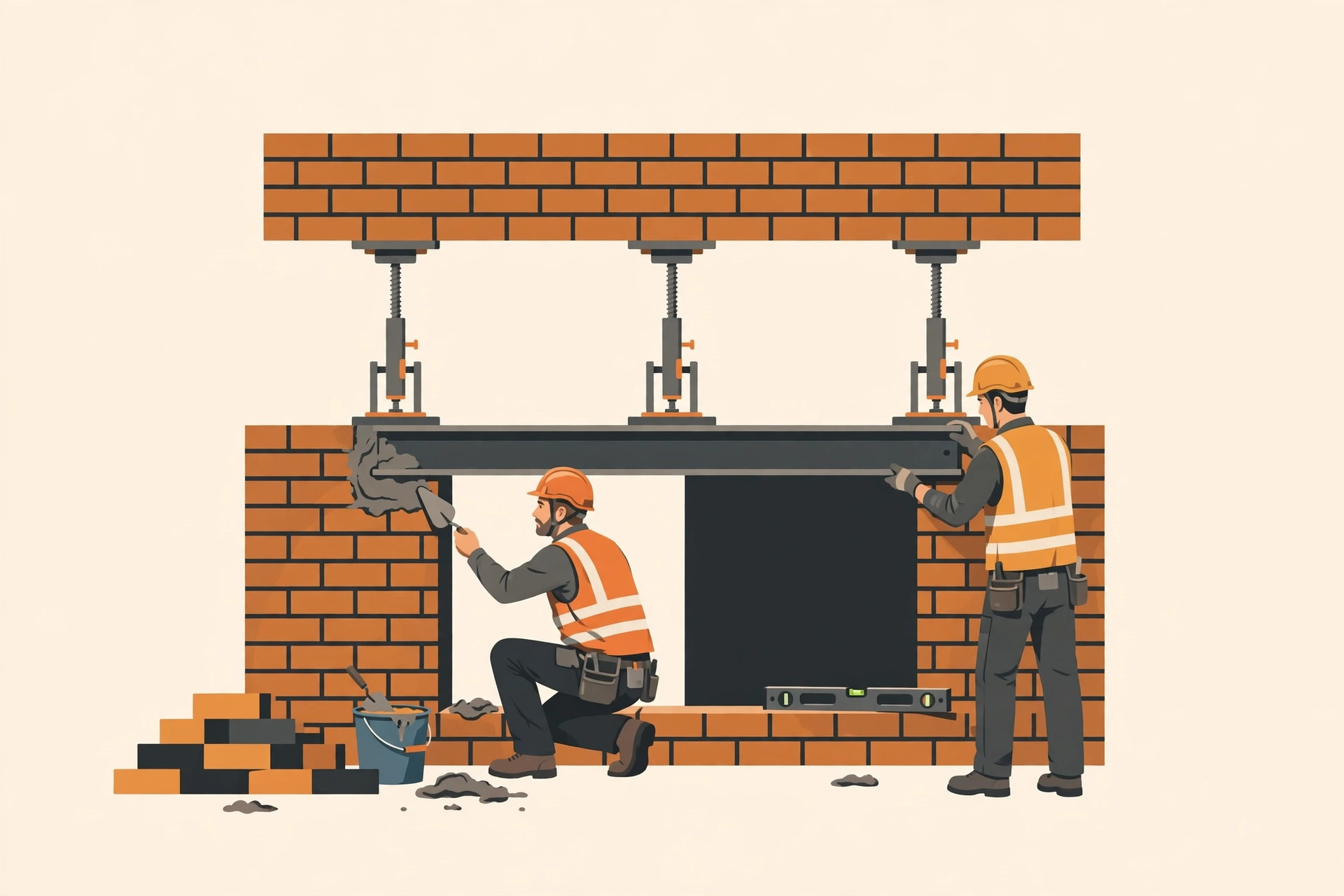
The beam you forget until it cracks
A lintel is a small beam carrying the wall over a door or window opening, throwing the load sideways onto the masonry at each end. Its evidence of failure is famous: the stepped crack climbing at 45 degrees from an opening's corner when the lintel is missing, undersized or rotted. Materials follow span and load: precast concrete for short spans and honest work, galvanised steel for cavity walls and longer spans, timber in old and light construction, and brick or stone arches where the geometry itself does the carrying. The lintel must suit the wall it serves, including cavity leaves carried separately or together as the detail demands, and a damp proof tray above it throws the weather back outside where it belongs.
Bearings, spans and propping sense
A lintel is only as good as its bearings: typically at least 150 millimetres of sound masonry at each end for domestic spans, more for heavy loads and steel, seated level on a full mortar bed. The load it carries is roughly the triangle of masonry above the opening plus whatever floors and roofs land inside that zone, which is why a lintel under a floor joist bearing is a different order from one over a garden door. When replacing a lintel, the wall above is propped before the old one moves, needles and strongboys doing quietly what hope cannot. Cutting a new opening follows the same liturgy: prop, cut, bed the lintel, pack and point, cure, then release the props in order. Every shortcut in that sequence has a crack named after it somewhere.
Openings are also arithmetic
Beyond structure, openings are money: every window and door is area you do not plaster, paint, tile or insulate, and area you must trim, seal and finish around. The trade convention in many places leaves small openings in the measured area because the cutting around them costs what the patch saves, while big openings come off in full; the time to agree that convention is before the work, in the quotation, not at the final account. The openings calculator on this site nets windows and doors off a gross wall area so painters, plasterers and renderers can price the same wall the same way. Measure openings at their structural size, count them once, and write the deduction rule on the quote; openings agreed are openings nobody argues about.