Measuring and Marking Out: Setting Out That Stays True
Lines first, building second
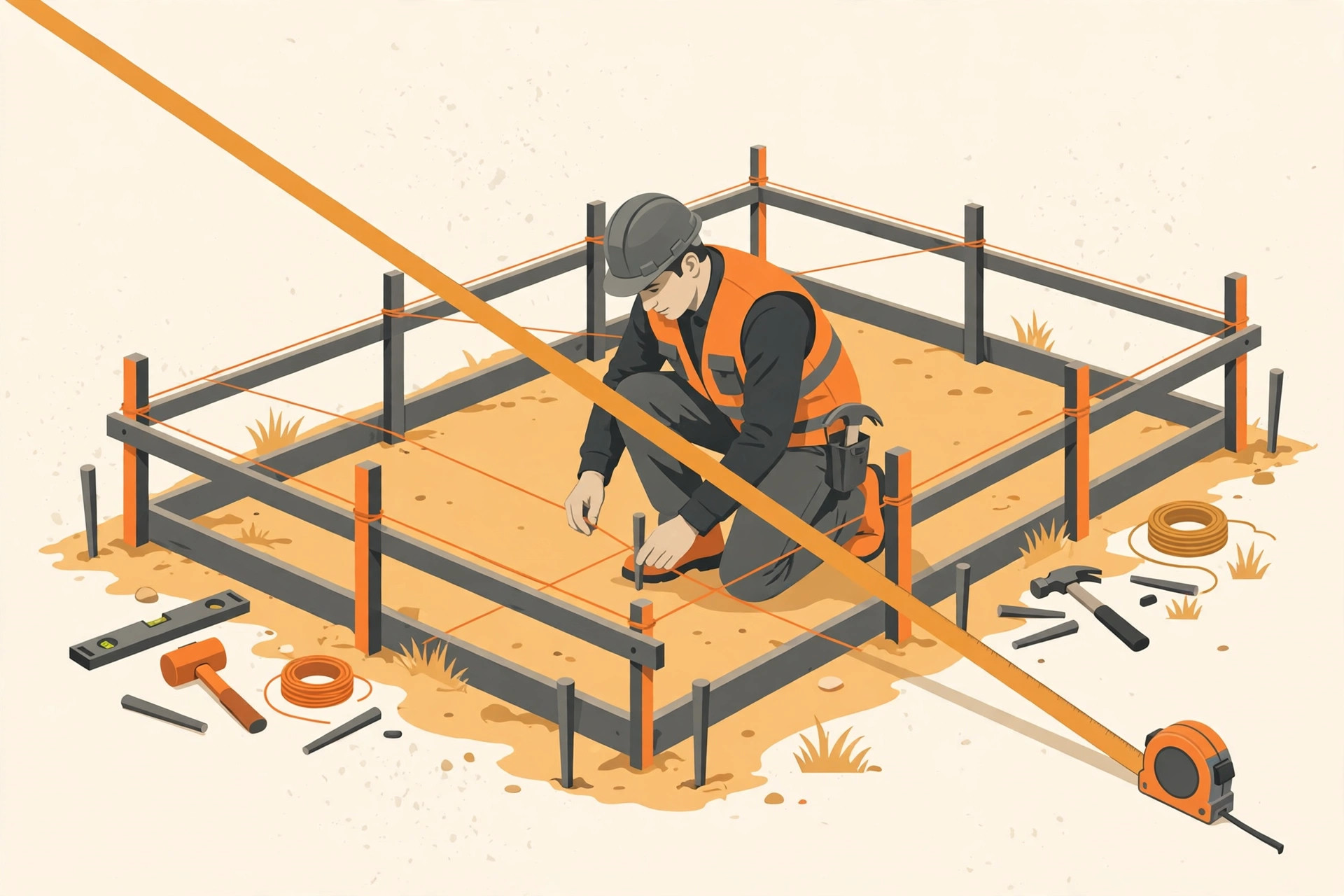
Setting out transfers the drawing to the ground, and every later trade inherits its accuracy. Start from fixed, checkable references: boundaries, existing buildings, survey points, never from a fence that may itself be wandering. Establish the main building lines with string lines between profile boards set back from the dig, so the strings survive the excavation and can be rehung to check the work at any stage. The humble string line, taut and level, remains the site's most honest instrument; protect it from boots, barrows and weather, and recheck it after every disturbance, because a moved profile moves the building with no announcement and total confidence.
Square is a measurement, not an opinion
Rectangles are proved by their diagonals: equal diagonals, a rectangle; unequal, a rhombus wearing a costume. The 3 4 5 triangle gives a true right angle anywhere: measure 3 along one line, 4 along the other, and adjust until the diagonal reads exactly 5, in any unit, scaled as large as the space allows for accuracy. Check square at the scale of the whole building, not at one corner, and repeat the diagonal check at foundation, at wall plate and at roof, because errors like to travel upward. A building 20 millimetres out of square at the base forgives; 200 millimetres taxes every fitted thing that follows, from stairs to kitchen units, and the tax is paid by whoever is holding the tape when it is discovered.
Levels and the datum discipline
One datum, clearly marked and protected, governs all heights on the job: a nail in a tree, a mark on a stable wall, a surveyed peg, transferred by water level, line level, laser or optical level according to the site's means. Every level on the building should trace back to that mark in one unbroken chain of readings, because two datums breed two buildings. Check instruments against themselves: a laser or level proved on two pegs at a distance is trusted; unproved, it is a rumour generator. Record the levels as you set them, photograph marks with the tape in frame, and recheck after frost, flood and enthusiastic plant movements. Setting out is an hour of care that purchases months of things fitting; it is the best bargain on any site. Few investments on site pay interest as reliably as that first careful hour. Guard it accordingly.
Put it into numbers
The free calculator that goes with this guide:
Open the cost per area calculator